
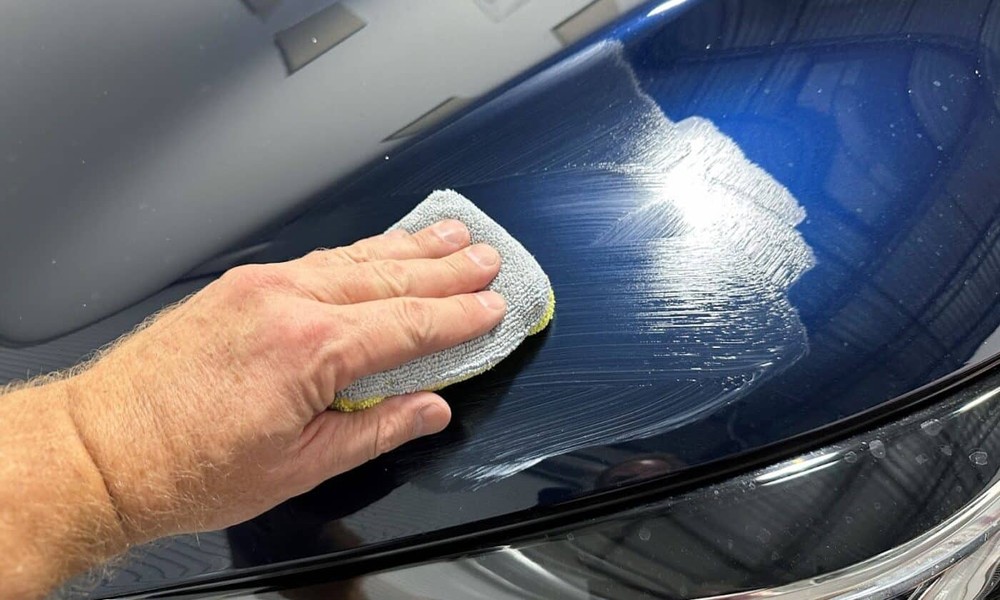
You wash the car, step back to admire it, and a few hours later there they are again: those faint cloudy rings scattered across the hood and doors. Water spots are one of the most common frustrations in car care, and also one of the easiest to make worse. The instinct is usually to grab whatever cloth is nearby and scrub. That instinct is exactly what damages the paint.
The good news is that most water spots come off cleanly when you understand what they actually are and work from the gentlest method upward. Here’s how to do that without leaving swirl marks, haze, or permanent etching behind.
What Water Spots Actually Are
A water spot isn’t really a stain in the paint. It’s what’s left behind after a droplet evaporates and the dissolved solids it was carrying stay put.
Tap water, sprinkler runoff, and rain all carry minerals. According to the U.S. Geological Survey, hard water is high in dissolved calcium and magnesium, and those minerals are the main culprits behind the chalky residue you see. When the water dries on a warm panel, the liquid disappears but the calcium carbonate and other deposits crystallize on the surface.
That distinction matters, because it tells you how to approach removal. You’re not bleaching a stain out of the clear coat. In most cases you’re dissolving or lifting a thin mineral crust off the top of it.
The Three Levels of Severity
Not every spot is equal, and treating a mild one like a severe one is how people scratch their finish.
Surface mineral deposits. These sit on top of the clear coat and feel slightly rough to the touch. They’re the most common and the easiest to remove.
Bonded deposits. Left long enough, or baked on by sun and heat, minerals can adhere more stubbornly. They resist a normal wash and need mechanical decontamination.
Etching. This is the serious one. When acidic or mineral-heavy water sits on hot paint, it can actually leave a faint crater or ring shape in the clear coat itself. You’ll often see it as a concave outline rather than a raised deposit. Etching usually requires polishing to correct, because the damage is in the surface, not on it.
Running your fingertips lightly over the area tells you a lot. Raised and gritty points to deposits. A visible ring you can see but not feel often points to etching.
Start Gentle: A Proper Wash First
Before reaching for anything aggressive, give the car a thorough wash. A surprising number of “water spots” disappear with nothing more than a careful clean.
Use a pH-neutral car shampoo rather than dish soap, which strips wax and protective layers. Work with the two-bucket method, one bucket for your soapy mitt and one with clean water for rinsing it, so you’re not dragging grit back across the paint. Wash in the shade on a cool panel whenever you can, since hot metal speeds up evaporation and creates fresh spots while you work.
Dry immediately with a clean microfiber towel or a plush drying towel. Letting the car air-dry simply restarts the whole problem.
For Stubborn Mineral Spots: A Mild Acidic Solution
If a wash doesn’t lift the deposits, the chemistry of the spot works in your favor. Mineral residue is alkaline, so a mildly acidic solution helps break it down.
A common detailer’s approach is a diluted white vinegar solution, roughly equal parts distilled water and vinegar. Mist it onto the affected area, let it dwell for under a minute, then wipe gently with a soft microfiber cloth and rinse thoroughly. Distilled water matters here, since rinsing with more hard water just reintroduces the minerals you’re removing.
A few sensible cautions: keep acidic solutions off glass-adjacent trim and never let them dry on the paint, and avoid this method entirely on a vehicle with active etching, where it does nothing useful. Spot-test an inconspicuous area first.
For Bonded Contamination: Clay, Not Pressure
When deposits have bonded to the surface and resist liquids, the answer is mechanical decontamination rather than harder scrubbing.
A detailing clay bar or clay mitt glides across a lubricated panel and pulls bonded contaminants off the clear coat. The key word is lubricated. Always use a generous clay lubricant or a quick-detailer spray so the clay floats rather than drags. Done correctly, claying removes what washing can’t while leaving the paint glassy-smooth. Done dry or with too much force, it marrs the finish, which is the opposite of what you want.
For Etched Spots: When Polishing Is the Real Fix
Here’s the honest part. If water has etched the clear coat, no spray or wash will bring it back. The only genuine repair is removing a microscopic layer of clear coat to level the surface, which is the work of machine polishing.
This is where a careful hand and the right products separate a clean result from a hazy, swirled one. Polishing with the wrong pad, compound, or technique can burn through the clear coat or introduce holograms. For deeper or widespread etching, this is the point where many owners hand the job to a professional rather than risk it, and a proper paint correction process is designed specifically to remove that kind of below-surface defect safely. Trained detailers measure clear coat thickness and work in controlled stages precisely because there’s a limit to how much material can be removed.
The wider detailing trade takes this seriously. Industry bodies such as the International Detailing Association run certification programs covering paint correction and surface care, which is a useful reminder that this is a learned skill, not a quick weekend hack.
Preventing Water Spots in the First Place
Removal is reactive. The smarter long-term play is making spots far less likely to form.
- Dry the car every time. Most spots are simply evaporation left unattended. A few minutes with a microfiber towel prevents hours of correction later.
- Avoid sprinklers and midday washing. Parking out of irrigation overspray and washing in cooler hours both cut down on baked-on residue.
- Add a protective layer. A quality wax, sealant, or ceramic coating makes the surface more hydrophobic, so water beads and rolls off instead of pooling and drying in place. Coatings don’t make a car spot-proof, but they buy you time and make cleanup easier.
- Consider filtered or deionized water. Rinseless and deionized water systems remove the minerals before they ever touch the paint, which is why so many enthusiasts use them for the final rinse.
When to Bring in a Professional
There’s no shame in calling for help, especially when etching is involved or the spots cover a large area. A professional has paint-depth gauges, dialed-in polishing equipment, and the experience to know when a panel can take correction and when it can’t.
If you’d rather not gamble with your clear coat, the mobile team at Cargo Detailing handles water spot removal and surface restoration as part of routine detailing work, and can assess whether a panel needs a light polish or full correction.
The Bottom Line
Water spots are almost always fixable, and rarely as serious as they look. The mistake isn’t the spot itself, it’s the rushed, abrasive response to it. Start with a proper wash, escalate only as far as the deposit requires, and reach for protection so the problem stops recurring. Work from gentle to aggressive, respect the clear coat, and your paint will keep its depth and gloss for years.

Comments are closed.