
China’s Robotaxi Investment Market Spotlights CaoCao Mobility as Interim Revenue Hits RMB10.3 Billion
On August 27, CaoCao Mobility (02643.HK) released its interim results for the six months ended June 30, 2026. The report shows that in the first half of 2026, the company achieved total revenue of RMB10.3 billion, up 9.0% year on year, while mobility service revenue reached RMB9.8 billion, up 13.9% year on year. As its core business maintained growth, the RoboX strategy previously unveiled by CaoCao Mobility further entered the implementation stage, making Robotaxi and AI-related businesses notable layout items beyond the current results, and providing a new corporate sample for market observations related to China’s robotaxi investment.
From the perspective of operating fundamentals, CaoCao Mobility’s mobility service scale continues to expand. As of June 30, 2026, the company’s service network covered 215 cities across China, with 20 new cities added in the first half of the year. Average monthly active users reached 44.6 million, up 17.1% year on year, and average monthly active drivers reached 758,000, up 36.8% year on year. Over the same period, gross margin was 9.0%, higher than 8.7% a year earlier. “CaoCao Brain” continues to use AI technology to optimize supply-demand matching, and the platform scale together with AI capabilities forms the operational foundation for the further development of the autonomous driving business.
Compared with traditional mobility platform businesses, the change brought by the RoboX strategy is that the company began advancing vehicles, intelligent driving, and the operations system within the same business framework. On June 18, CaoCao Mobility launched the RoboX strategy, building a world-leading physical AI mobility technology platform around the trinity development model of “intelligent purpose-built vehicles + intelligent driving technology + intelligent operations“, and connecting its existing capabilities-including vehicle operations, capacity dispatching, safety management, and user services-with autonomous driving technology. This layout also extends the observation dimensions of China’s robotaxi investment from single-vehicle technology to platform-based operational capability.
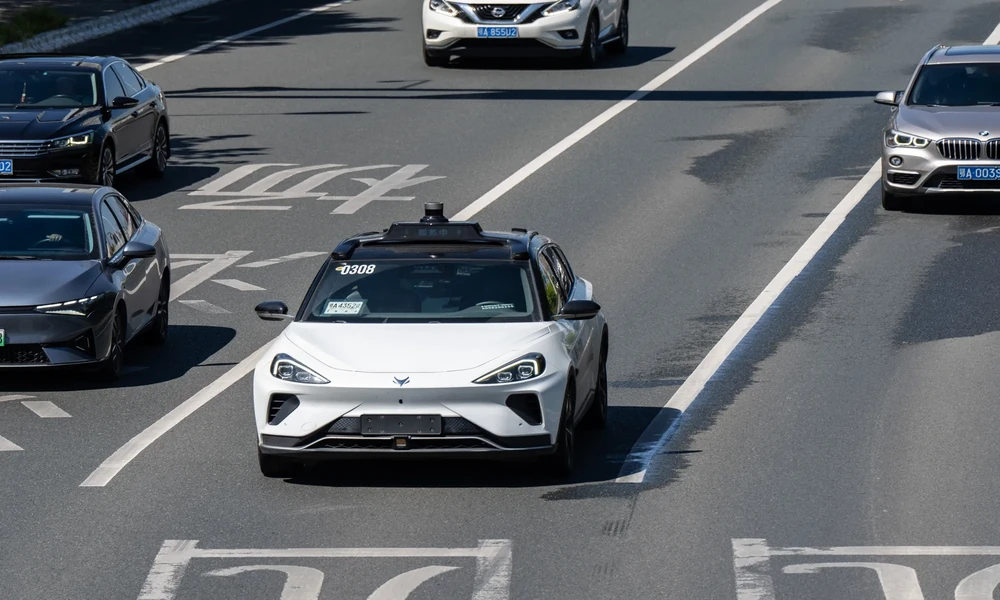
As the most important commercialization vehicle for Geely Holding Group’s Robotaxi, CaoCao Mobility continues to advance its vehicle-side product planning. As of June 30, 2026, CaoCao Mobility had deployed 140 second-generation Robotaxis and plans to continue deploying more vehicles in domestic and overseas markets in the second half of 2026. At the same time, the company is advancing its third-generation natively developed Robotaxi, Eva Cab. The model adopts a no-front-passenger-seat, steering-wheel-free design and is scheduled to enter mass production in 2027. Under current plans, the company aims to cumulatively deploy 100,000 purpose-built Robotaxis by 2030, providing the vehicle foundation for the subsequent expansion of autonomous mobility services.
Beyond vehicles and autonomous driving technology, AI is becoming an important tool for CaoCao Mobility to connect users with mobility services. In June 2026, the company joined the Doubao AI ecosystem and jointly built AI ride-hailing services; in September, it further integrated with the Doubao mobile assistant, while continuously exploring the combination of AI and Robotaxi services. The company also proposed a “ground-air-space integrated smart mobility” model exploring the coordination of Robotaxis with low-altitude aircraft, connecting the autonomous driving business with broader intelligent transportation scenarios.
Overseas markets are also an important component of the RoboX strategy. CaoCao Mobility has designated Hong Kong, China and the United Arab Emirates as its first key expansion markets, and plans to establish a joint venture with Octopus. In June 2026, the company signed strategic cooperation with K2, a local partner in Abu Dhabi, to advance Robotaxi project deployment and operations, while continuously promoting relevant cooperation with partners including May Mobility. Supporting systems such as the Green Intelligent Mobility Hub also provide corresponding service support for scaled Robotaxi operations.
From the interim results and business planning, it can be seen that CaoCao Mobility’s exploration of Robotaxi is not detached from its original mobility platform, but gradually incorporates AI, vehicle development, intelligent driving, and operational capabilities into the same business system. For market attention related to China’s robotaxi investment, enterprises’ operating scale, technology R&D, vehicle planning, and robotaxi commercialization operational capability are becoming multiple observation dimensions for understanding the development of the Robotaxi industry.
From the interim results and business planning, it can be seen that CaoCao Mobility’s exploration of Robotaxi is not detached from its original mobility platform, but gradually incorporates AI, vehicle development, intelligent driving, and operational capabilities into the same business system. For market attention related to China’s robotaxi investment, enterprises’ operating scale, technology R&D, vehicle planning, and robotaxi commercialization operational capability are becoming multiple observation dimensions for understanding the development of the Robotaxi industry.

Comments are closed.